

Medical Anxiety: What It Is, Why It Happens and How Counselling Can Help
What causes medical anxiety?
When it comes to medical anxiety, there is rarely one simple cause. Sometimes it can develop over time following a single or multiple difficult healthcare experiences. This could be:
Emergency admission
Painful procedures
Invasive procedures
Traumatic birth
Surgery
an experience where you felt powerless or ignored
This is sometimes referred to as medical trauma.
Medical anxiety can also develop after witnessing someone else becoming seriously ill, particularly someone close to you. Bereavement and loss can understandably change the way we think about our own health, illness and mortality.
Sometimes, there is just no clear starting point that someone can put their finger on. It could be that general anxiety, past experience, family attitudes towards illness and difficulty coping with uncertainty can all contribute.
The cycle of health anxiety
The internet can add another layer. When we are frightened, searching symptoms can feel like a sensible way to reassure ourselves. Unfortunately, it can sometimes do the opposite. Most internet searches continue until we hit a whole range of frightening possibilities. A search about a headache may eventually look like a brain tumour. This all increases anxiety and encourages us to keep on checking.
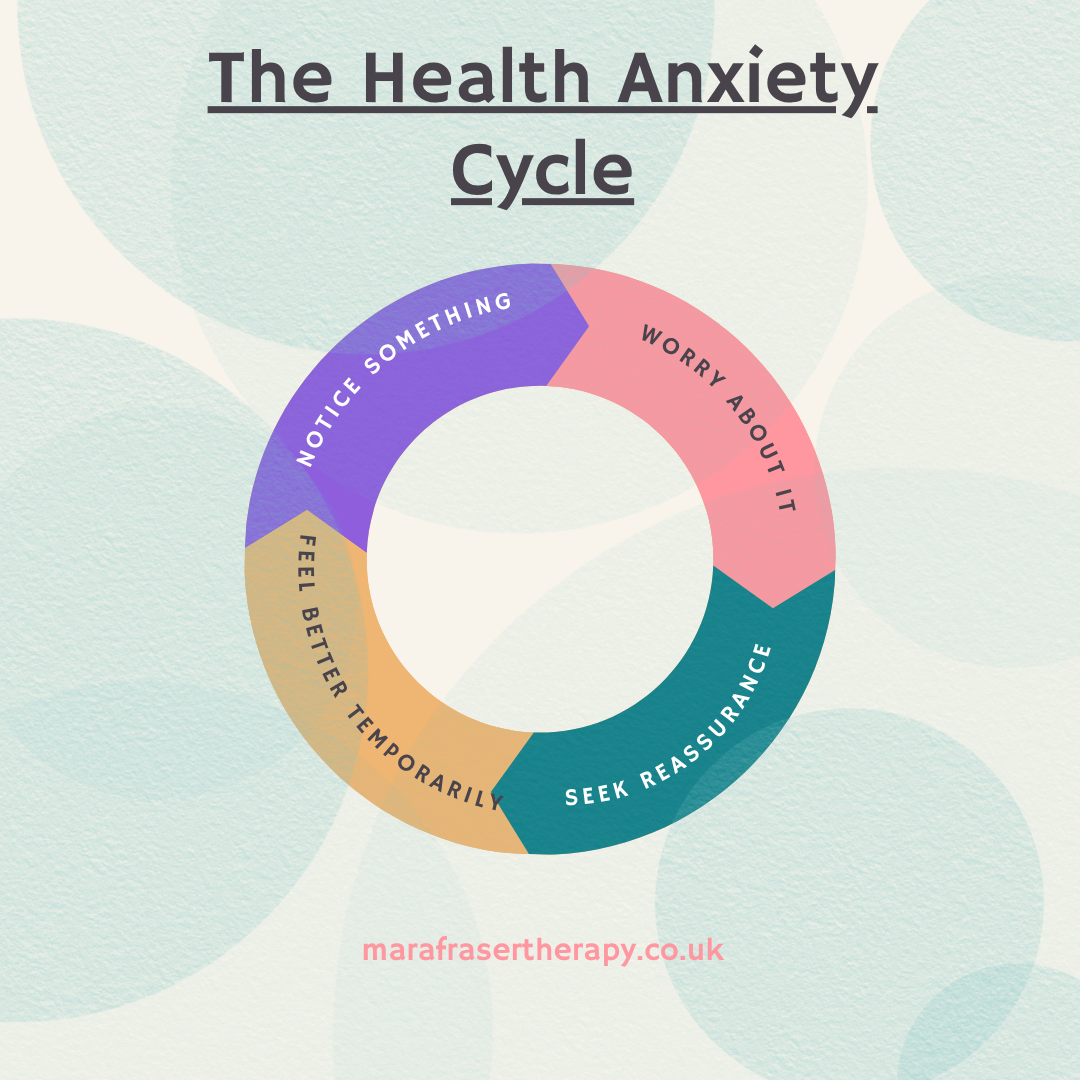
A cycle can gradually develop
Notice something → worry about it → check or seek reassurance → feel better temporarily → notice something else → worry again.
Understanding this cycle can be an important part of learning how to respond differently to medical anxiety.
Fear of medical appointments and procedures
Not everyone with medical anxiety is primarily worried about illness. There is a whole range of anxieties that people experience and these range from anxiety around
Medical appointments
Hospitals
Needles
Blood tests
Injections
Scans
Many other procedures.
A common response is to avoid appointments and, while this often does provide short-term relief, long term it works against someone’s ability to access healthcare. The thought of making even a simple GP appointment becomes increasingly difficult.
Can counselling help with medical anxiety?
Counselling provides a space to explore what is underneath your medical anxiety rather than simply being told not to worry. Together, we might look at what triggers your anxiety, the thoughts and fears that follow and the ways you have learned to cope. This can include:
Understanding patterns such as body checking, reassurance seeking, avoidance
Repeatedly searching for health information.
Developing ways of managing anxious thoughts and physical sensations without allowing them to take over.
Medical anxiety linked to trauma
Where medical anxiety is connected to a previous traumatic experience, trauma-informed approaches may also be helpful. I offer Rewind Therapy where appropriate, which can be used to work with traumatic memories without requiring you to describe or repeatedly relive the experience in detail. Individualised assessment is important to decide whether this approach is suitable for you.
Living with uncertainty rather than fear
The aim of counselling for medical anxiety is not to persuade you that nothing bad will ever happen. None of us can have that certainty. Instead, counselling can help you become more able to tolerate uncertainty, understand your anxiety and make decisions about your health based on what you need rather than what anxiety is telling you to fear.
Medical anxiety can make your world feel increasingly small. With the right support, it doesn't have to stay that way.